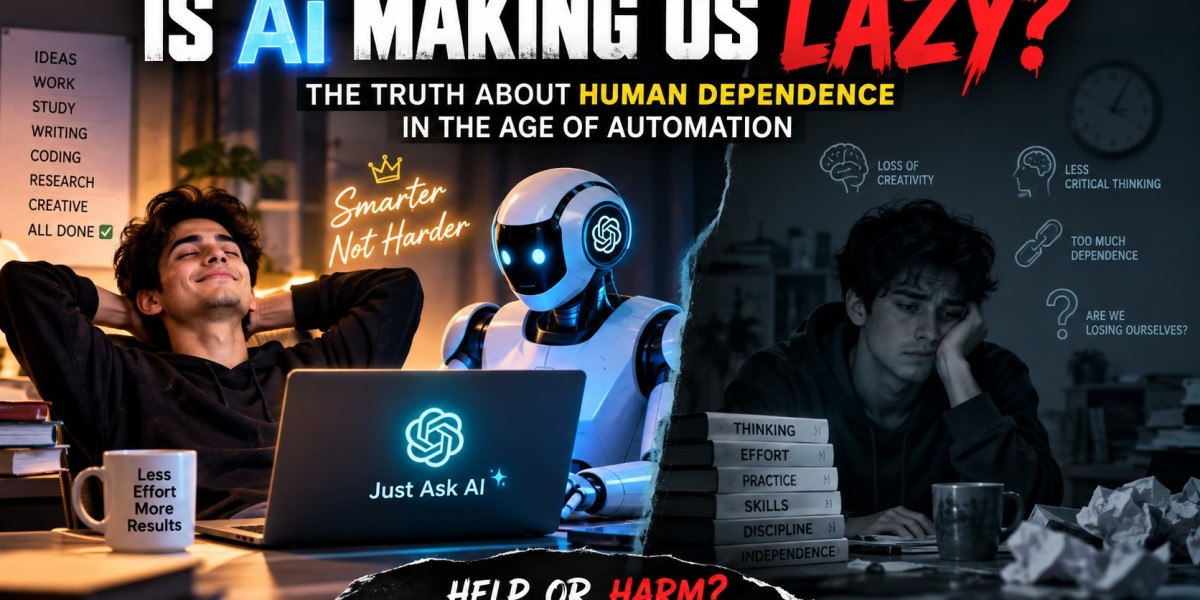

The Algorithm Effect: Is AI Making Us Lazier?
Artificial Intelligence (AI) has rapidly permeated nearly every facet of modern life—from writing our emails to suggesting what we watch next. It is a revolutionary force, promising unparalleled efficiency and access to information. But as these powerful tools become more integrated into our daily routines, a quieter concern is beginning to surface: Are we outsourcing too much of our cognitive load? Is the sheer convenience provided by AI subtly dulling our innate human skills?
This question—whether technology designed to help us is inadvertently making us cognitively lazy—is one of the most crucial discussions of the digital age. We are swimming in an ocean of automated solutions, and understanding this trade-off between efficiency and effort is vital for our future intellectual health.
The Pillars of AI Convenience: Where Is the Comfort?
AI excels at prediction and completion. It fills in missing words as we type, drafts complex summaries from dense reports, and navigates intricate logistical challenges with a few prompts. This seamless functionality is incredibly valuable; it saves time, which is arguably our most precious resource.
Information Retrieval vs. Knowledge Construction
Consider the shift in research. Years ago, learning something new required deep dives into multiple textbooks, hours spent cross-referencing primary sources, and developing the ability to synthesize disparate ideas manually. Today, we ask a sophisticated model, and it spits out a seemingly coherent answer.
The ease of this instant retrieval risks creating a dependency on external scaffolding. If the mental muscle required for deep searching, connecting obscure dots, or grappling with ambiguity isn't exercised regularly, that muscle can atrophy—a phenomenon akin to physical disuse.
Writing and Thought Outsourcing
Generative AI tools are masters of prose. They can structure an argument, adopt a specific tone, and generate polished text in seconds. For students and professionals alike, this is a massive boon for overcoming writer's block or meeting tight deadlines. However, the process of writing itself—the struggle to find the *perfect* word, the painstaking revision, the wrestling with complex syntax—is integral to developing critical thinking.
When AI does the heavy lifting of structuring thought, the user risks becoming adept at prompt engineering rather than deep argumentation. The skill shifts from knowing how to think to knowing what to ask.
The Cognitive Load Theory and Our Digital Over-Reliance
Cognitive load theory suggests that our working memory has limited capacity. We rely on external aids (like calculators, GPS, or search engines) precisely because they offload routine mental tasks, freeing up bandwidth for higher-level problem-solving. AI is the ultimate external aid.
The laziness concern arises when the scaffolding becomes too robust and invisible. If we stop remembering basic procedures—like how to navigate a physical map without GPS, or how to structure an essay outline without a digital prompt guide—we haven't saved cognitive energy; we’ve merely relocated the necessary effort into maintaining our relationship with the technology.
The Skill Gap: What Are We Forgetting How To Do?
The real danger isn't in using AI; it's in treating it as a magical replacement for foundational skills. Several areas show clear signs of potential skill degradation:
- Deep Reading Comprehension: The tendency toward skimming and headline reading, expecting the summary to cover all nuances.
- Systemic Problem Solving: Relying on AI to suggest the "best path" instead of mapping out multiple potential pathways manually.
- Mental Arithmetic & Quick Recall: Over-relying on digital tools for simple calculations or remembering common facts that were once stored in long-term memory through repetition and necessity.
This isn't an indictment of the technology, but a call for mindful usage. We need to differentiate between augmentation (AI helping us think faster) and automation (AI doing the thinking for us).
Strategies to Stay Sharp: Using AI Without Becoming Complacent
The goal is not Luddism; it's renaissance thinking. We must become 'smart collaborators' with our tools, rather than mere passive recipients of their output.
1. Embrace the Struggle (Productively)
When faced with a writing task or a problem set, institute a "pre-AI drafting" phase. Force yourself to write the first draft, however rough, without any assistance. Use AI later for refinement, tone adjustment, or expansion, rather than creation.
2. Verify Everything
Treat all AI output—especially facts, statistics, and complex arguments—as a highly educated but fallible junior colleague. Always trace the sources and challenge the premise. This act of critical verification is the ultimate cognitive workout.
3. Focus on Synthesis Over Output
Shift your goal from "getting an answer" to "understanding why that answer works." If AI generates a solution, spend more time reverse-engineering its logic than accepting its conclusion. Ask: "If this premise were false, how would the entire structure collapse?"
Conclusion: The Human Element Remains Paramount
AI is an unparalleled amplifier of human potential. It handles the tedious, repetitive groundwork, allowing us to tackle problems at a grander scale—space exploration, complex climate modeling, or novel scientific breakthroughs.
The fear of laziness is less about the silicon and more about our own habits. The key to navigating this technological boom without becoming intellectually soft lies in intentional friction: deliberately reintroducing productive struggle into our workflows. By treating AI as an infinitely patient research assistant rather than a magical oracle, we ensure that while our efficiency skyrockets, our fundamental human capacity for deep thought remains robust and vibrant.
Key Takeaways for Maintaining Cognitive Edge
- Be the Editor, Not Just the Prompter: Focus effort on refining AI output.
- Prioritize Process Over Product: Value the difficult journey of creation as much as the polished final piece.
- Practice Foundational Skills Weekly: Keep your core critical thinking and recall muscles warmed up with analog tasks.