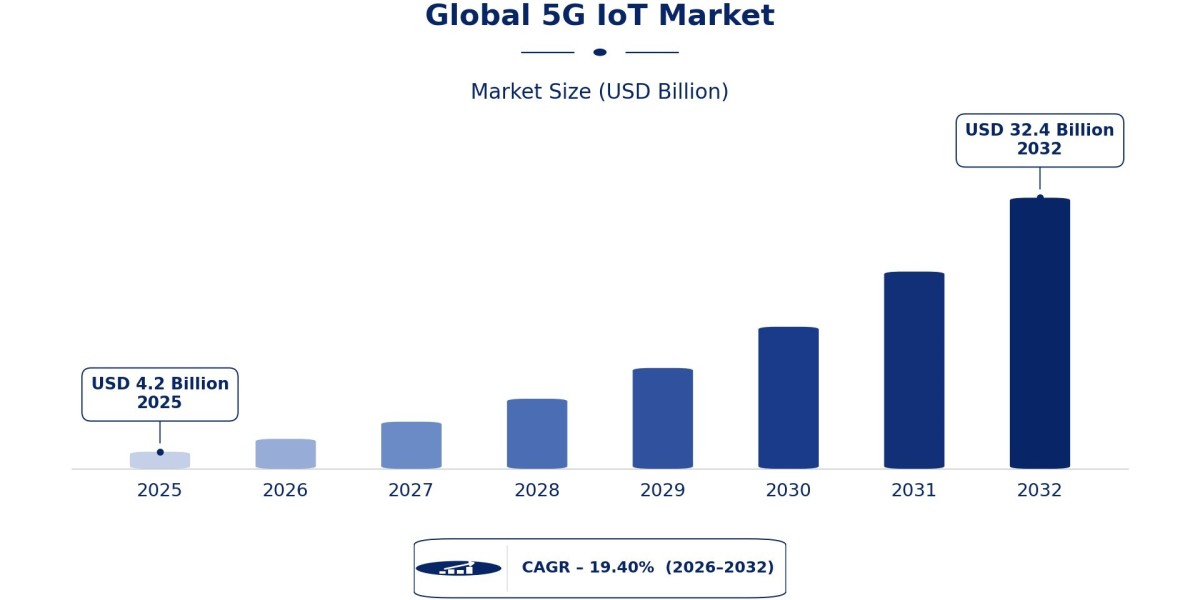

The evolution of 5G is moving beyond faster mobile broadband toward networks designed to support increasingly sophisticated connected applications. This shift is particularly relevant to the 5G IoT Market, where IoT devices require dependable connectivity, low latency, scalability, and flexible network capabilities. 6Wresearch estimates the global market at USD 4.2 billion in 2025 and forecasts USD 32.4 billion by 2032, representing a 19.40% CAGR during 2026–2032.
What Is 5G Standalone?
5G networks can broadly be deployed through standalone and non-standalone architectures.
Non-standalone networks use existing 4G infrastructure alongside 5G radio technology. This approach has helped operators introduce 5G while leveraging existing investments.
Standalone 5G uses a dedicated 5G core network and can support advanced capabilities designed for new applications.
Why Does Architecture Matter for IoT?
IoT applications are highly diverse.
A smart meter may require small amounts of data periodically. A connected industrial robot may need low-latency communication. A smart-city camera may generate large quantities of information.
One network therefore needs to accommodate very different requirements.
5G architecture can help operators support these varied use cases.
Network Slicing
Network slicing is one technology associated with advanced 5G networks.
It can allow operators to create logical network environments with different performance characteristics over shared infrastructure.
For IoT applications, this could enable networks to be configured according to application requirements.
For example, a critical industrial application could require different performance characteristics from a consumer IoT application.
Ultra-Reliable Low-Latency Communication
Some IoT applications depend on rapid communication.
Industrial automation, connected vehicles, robotics, and certain public infrastructure applications may require very low latency and high reliability.
Standalone 5G is designed to support advanced network capabilities that can help address these requirements.
Massive IoT Connectivity
Another major opportunity involves the sheer number of devices.
Smart cities, industrial facilities, utilities, agriculture, and logistics operations can contain thousands or even millions of connected endpoints.
Network infrastructure needs to accommodate these devices efficiently.
5G's focus on massive machine-type communication provides an important foundation for large-scale IoT deployment.
Private 5G and Enterprise Networks
Enterprises are also exploring private 5G networks.
Factories, ports, warehouses, mines, campuses, and other large facilities can deploy dedicated networks for connected operations.
This can provide organizations with greater control over connectivity and network configuration.
Private networks can therefore become an important bridge between telecommunications infrastructure and enterprise IoT.
Edge Computing Completes the Ecosystem
5G and edge computing are closely connected.
When data is generated by IoT devices, processing it near the source can reduce latency and unnecessary data movement.
An industrial facility, for example, could deploy edge computing resources within or close to the facility.
This allows connected devices to communicate with nearby computing infrastructure while still integrating with broader cloud systems.
Standalone Growth
6Wresearch states that 5G non-standalone networks held the larger share in 2025, estimated at about 60%, while standalone networks are projected to grow at a 25% CAGR from 2026 to 2032.
This reflects the transition from initial 5G deployment strategies toward architectures capable of supporting more advanced use cases.
What Challenges Remain?
The transition to advanced 5G networks requires investment.
Operators need to consider:
Spectrum
Core-network upgrades
Infrastructure
Device compatibility
Security
Enterprise integration
Network management
Enterprises also need compatible devices and applications to take advantage of advanced network capabilities.
The Next Phase of IoT
The future of IoT will depend partly on the networks connecting billions of devices.
As 5G standalone deployments expand, enterprises can explore applications requiring greater reliability, flexibility, and responsiveness.
The 5G IoT Market is therefore closely connected with the evolution of network architecture itself.
Who We Are
About 6Wresearch: 6Wresearch is a commercial strategy and growth advisory firm founded in 2011 and headquartered in New Delhi, India, with partners across Southeast Asia and the Middle East & Africa. The firm has delivered over 20,000 commercial engagements for over 2,000 organizations, including Fortune 500 companies, government agencies, and multilateral institutions such as the World Bank and the Asian Development Bank. Backed by proprietary market research and advanced analytics, 6Wresearch combines sector expertise with data-driven intelligence to help organizations navigate market complexity and drive sustainable growth. These capabilities explain why organizations trust 6Wresearch Global Market Research & Consulting Firm for reliable commercial insights and confident decision-making.
Our Proprietary Platform: 6W Export GTM
6W Export GTM is 6Wresearch's proprietary trade intelligence and go-to-market platform, built on UN Comtrade data and enhanced with 6Wresearch's in-house analytical and simulation models, including system dynamics-based forecasting. Unlike broad, sector-level market sizing tools, 6W Export GTM operates at the individual product level down to specific HS codes and micro-segments to identify precise, actionable export opportunities by country and product pair, including markets where trade currently does not exist. This granular, simulation-driven approach allows 6W Export GTM to surface opportunities that sector-wide analysis typically misses, positioning it among a small number of platforms globally offering this depth of product-and-country-specific export intelligence.