
The Japan Iodine Market depends not only on demand from healthcare, electronics, and industrial manufacturing but also on the international supply chains that deliver iodine and iodine-containing materials to Japanese buyers. Because production is concentrated in particular regions, global trade patterns, shipping conditions, and supplier relationships can influence procurement decisions across several industries.
According to 6Wresearch, the market is projected to grow at a 9.3% CAGR between 2026 and 2032. For importers, distributors, and chemical manufacturers, understanding the trade environment is essential to converting this market potential into reliable commercial opportunities.
Why Does International Trade Matter?
Iodine is used across multiple sectors, including pharmaceuticals, X-ray contrast media, optical polarizing films, fluorochemicals, animal feed, and human nutrition. Each application has its own material requirements, meaning buyers need more than a general understanding of iodine availability.
International procurement decisions may depend on:
The origin and reliability of supplies.
Exporter production capacity.
Shipping costs and transit times.
Product specifications and purity requirements.
Contract terms and currency movements.
The availability of qualified alternative suppliers.
A change in international supply conditions can affect purchasing costs even when demand within Japan remains stable.
What Do Trade Concentration and Market Volatility Mean?
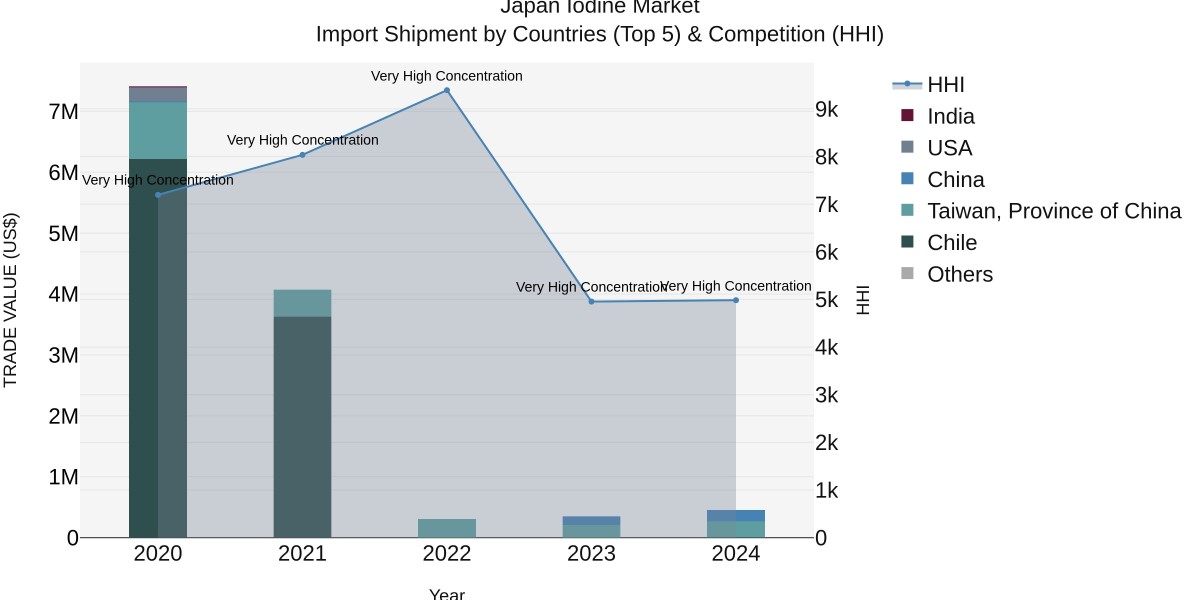
The 6Wresearch reference page identifies Taiwan, China, Chile, India, and the United States among Japan’s leading iodine import shipment origins in 2024. It also reports notable changes in import shipment patterns over the 2020–2024 period, including a negative CAGR and growth between 2023 and 2024.
These figures concern trade shipments and should not be confused with the forecast growth rate of the overall iodine market. Shipment values and volumes can change because of purchasing cycles, trade flows, pricing, or reporting periods.
For procurement teams, the key lesson is to evaluate several years of trade data rather than relying on a single year.
How Can Importers Strengthen Their Supply Chains?
1. Diversify Qualified Suppliers
Businesses can assess alternative exporters to reduce dependence on a narrow supply base. However, diversification should include technical qualification, product testing, and delivery assessments rather than simply adding suppliers to a list.
2. Monitor Trade Flows
Importers should track supplier-country performance, shipment frequency, trade values, and changes in sourcing patterns. These indicators can help identify potential disruptions and changes in procurement conditions.
3. Improve Inventory Planning
Inventory policies should reflect lead times, demand variability, storage requirements, and the cost of holding materials. Critical applications may require different inventory arrangements from products with more flexible procurement options.
4. Negotiate Flexible Contracts
Businesses may benefit from contract structures that clarify quality specifications, delivery commitments, pricing mechanisms, and contingency procedures. The appropriate arrangement depends on the product and the buyer’s risk tolerance.
Which Applications Influence Procurement Strategy?
The iodine market covers several source, form, and application categories.
Sources: Caliche ore, underground brines, recycling, and seaweeds.
Forms: Organic compounds, inorganic salts and complexes, and elemental iodine and isotopes.
Applications: Pharmaceuticals, X-ray contrast media, optical polarizing films, catalysts in polymer processing, animal feed, fluorochemicals, human nutrition, and others.
Medical and pharmaceutical buyers may emphasize strict specifications and traceability. Industrial users may place greater emphasis on process compatibility and cost, while nutritional products require suitable ingredient quality and regulatory compliance.
These differences make application-level demand analysis valuable for suppliers and importers.
What Risks Should Businesses Watch?
International Disruptions
Geopolitical developments, shipping constraints, and changes in export conditions can influence availability and landed costs.
Price Uncertainty
International prices may respond to changes in production, demand, logistics, and supplier competition. Buyers should assess total procurement cost rather than purchase price alone.
Qualification Barriers
An alternative supplier may offer competitive pricing but fail to meet a customer’s technical specifications. Testing and qualification can take time, so contingency planning should begin before a disruption occurs.
Limited Market Visibility
Trade statistics provide useful evidence, but they do not explain every commercial factor. Businesses should combine trade analysis with customer interviews, supplier assessments, and industry-specific research.
How Can Trade Intelligence Support Better Decisions?
Companies can use structured market intelligence to identify promising supply partners, monitor changing trade routes, and assess potential export opportunities. Product-level analysis can be especially useful when broad industry data obscures differences between specific iodine compounds and end uses.
A practical trade strategy combines reliable data with commercial judgment. Historical trade flows should be reviewed alongside product requirements, logistics, market access, and expected demand.
What Is the Outlook for Japan’s Iodine Trade?
Japan’s iodine market offers opportunities across healthcare, electronics, nutrition, and industrial chemicals. However, the ability to capture those opportunities depends partly on the resilience of international procurement and distribution networks.
The 9.3% CAGR forecast for 2026–2032 reported by 6Wresearch provides a broader market reference. Importers and exporters can improve their readiness by diversifying supply relationships, tracking trade developments, and matching specific products to suitable customers.
Who We Are
About 6Wresearch: 6Wresearch is a commercial strategy and growth advisory firm founded in 2011 and headquartered in New Delhi, India, with partners across Southeast Asia and the Middle East & Africa. The firm has delivered over 20,000 commercial engagements for over 2,000 organizations, including Fortune 500 companies, government agencies, and multilateral institutions such as the World Bank and the Asian Development Bank. Backed by proprietary market research and advanced analytics, 6Wresearch combines sector expertise with data-driven intelligence to help organizations navigate market complexity and drive sustainable growth. These capabilities explain why organizations trust 6Wresearch Global Market Research & Consulting Firm for reliable commercial insights and confident decision-making.
Our Proprietary Platform: 6W Export GTM
6W Export GTM is 6Wresearch's proprietary trade intelligence and go-to-market platform, built on UN Comtrade data and enhanced with 6Wresearch's in-house analytical and simulation models, including system dynamics-based forecasting. Unlike broad, sector-level market sizing tools, 6W Export GTM operates at the individual product level down to specific HS codes and micro-segments to identify precise, actionable export opportunities by country and product pair, including markets where trade currently does not exist. This granular, simulation-driven approach allows 6W Export GTM to surface opportunities that sector-wide analysis typically misses, positioning it among a small number of platforms globally offering this depth of product-and-country-specific export intelligence.