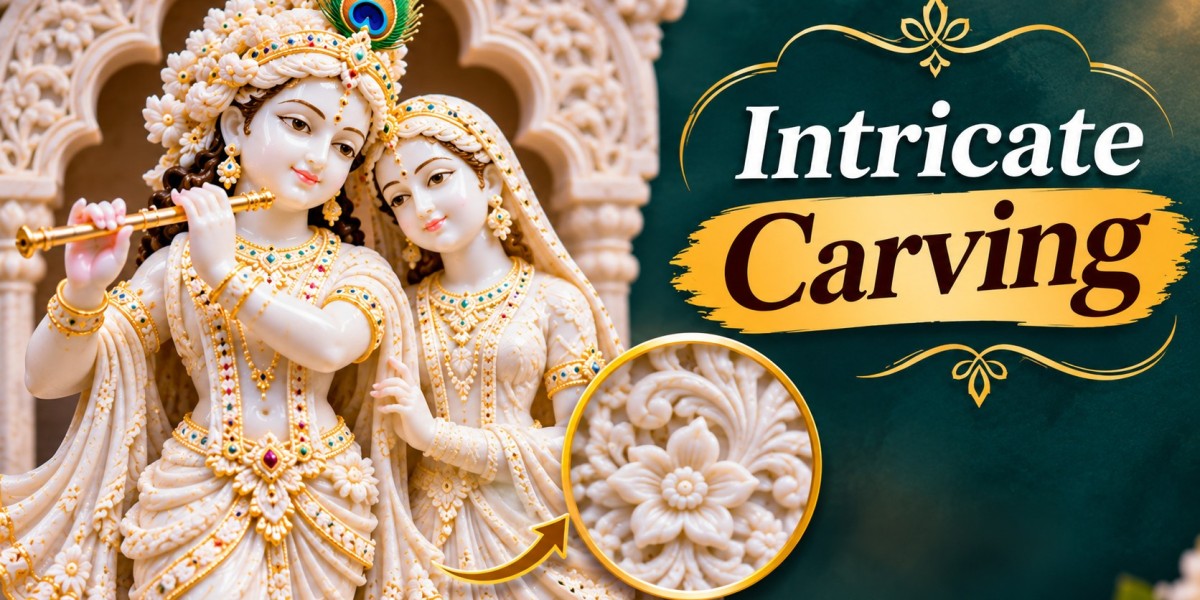

A marble statue can be admired for its material, shape, and overall design, but intricate carving often gives it a distinctive visual character. In Radha Krishna murtis, detailed work may be seen in facial expressions, garments, crowns, ornaments, and decorative bases. These features require patience and careful workmanship, especially when the statue is created by hand.
For buyers who appreciate traditional artistry, an intricately carved Radha Krishna Murti can become a meaningful focal point in a home temple. Understanding what makes detailed carving special can help you recognise good workmanship and choose a statue that suits your preferences.
Why Does Intricate Carving Attract Attention?
Detailed carving creates visual depth and gives the statue more elements to explore. Instead of appearing as a simple sculpted form, the murti may include carefully shaped garments, ornamental patterns, jewellery, and other traditional features.
These details can make the statue look more elaborate while highlighting the artisan's skill. However, the quality of a design depends on how well the details are executed. A statue does not become superior simply because it contains more decoration.
Good carving should look balanced and consistent. The decorative features should support the overall composition rather than distract from the figures.
How Do Facial Expressions Influence the Beauty?
The faces of Radha and Krishna are among the most noticeable parts of the statue. Their expressions contribute significantly to its overall appearance.
Look for carefully shaped eyes, lips, nose, and facial contours. The features should be proportionate and neatly finished. If the expressions appear uneven or poorly defined, the statue may not have the refined appearance you expect.
When purchasing online, request close-up images of both faces. A front-facing photograph may not show every detail, so images from slightly different angles can be useful.
What Makes Garment Carving Special?
Garments provide an opportunity for artisans to create texture and movement in marble. Traditional clothing may include flowing folds, decorative borders, and patterned details.
Carefully carved folds can make the clothing appear more natural and give the figures a graceful appearance. Examine whether the lines are clean and whether the patterns remain consistent across the design.
The level of detail should also suit the size of the statue. Very small murtis may have fewer visible details, while larger designs may allow more elaborate carving.
Why Are Crowns and Ornaments Important?
Crowns, necklaces, and other ornaments contribute to the traditional character of many Radha Krishna statues. They may include layered patterns and decorative elements that require careful shaping.
These features should be examined closely because narrow or projecting parts can be delicate. Look for clean finishing and check whether any parts appear chipped or damaged.
If the murti will be transported over a long distance, ask the seller how the delicate ornaments will be protected during packaging.
How Does the Marble Affect Intricate Carving?
Marble quality can influence the carving process and the final finish. Natural variations in colour and texture may affect the appearance of detailed areas.
Ask the seller about the stone used and whether the product has a polished or other surface finish. Request photographs of the actual statue where possible, since natural stone may differ slightly from sample images.
The marble and the artisan's skill should be evaluated together. Even a suitable material requires careful workmanship to produce a well-finished statue.
What Is the Role of the Decorative Base?
The base provides support and forms part of the statue's overall design. Some intricately carved murtis feature decorative patterns or ornamental details that complement the figures.
A good base should be visually balanced and stable. Check the underside and edges if possible, and confirm that the platform in your home temple can support the statue's weight.
The base should not be overlooked when measuring the murti because it contributes to the overall dimensions.
How Can You Identify Good Intricate Workmanship?
Look at the statue as a complete composition rather than focusing on one attractive feature. The faces, garments, ornaments, posture, and base should work together.
Consider these points:
Details should be clearly defined and neatly finished.
The figures should have balanced proportions.
Decorative patterns should appear consistent.
Delicate features should not show visible damage.
The surface should be finished appropriately for the marble.
The overall design should look harmonious from different angles.
For online purchases, ask for clear photographs and detailed product specifications. If possible, compare similar designs before making a decision.
Is an Intricately Carved Murti Suitable for Every Home Temple?
Not always. Highly detailed statues may have larger dimensions or more delicate features, depending on the design. A compact mandir may be better suited to a simpler statue that fits comfortably within the available space.
Consider how much room is available for worship and cleaning. Also think about how the statue will be handled and maintained. The best design is one that suits your space and can be cared for properly.
Conclusion
Intricately carved Radha Krishna murtis stand out because of the attention given to facial expressions, garments, ornaments, proportions, and decorative bases. The beauty of the statue depends on the quality of the marble and the artisan's ability to bring these details together in a balanced design. Explore Radha Krishna marble murtis to compare traditional designs and choose one that reflects your preferred style.
Frequently Asked Questions
1. What makes an intricately carved murti different?
It features additional sculptural details in areas such as garments, ornaments, facial features, and the base.
2. Are detailed marble murtis always better?
Not necessarily. The quality of the workmanship and the balance of the design matter more than the number of decorative details.
3. How can I check intricate carving online?
Request close-up photographs of the face, garments, ornaments, and base from multiple angles.
4. Does marble quality affect carving details?
Yes. The characteristics of the stone can influence the carving process and final appearance, along with the artisan's skill.
5. Are delicate carved features difficult to maintain?
They may require careful dusting and handling. Use a soft brush where appropriate and follow the maker's care instructions.
6. Can I order an intricately carved custom murti?
Some artisans accept custom requests. Discuss the design, dimensions, production time, and price before confirming.