
Launching a mobile application is only the beginning. Once an app reaches users, businesses must regularly fix bugs, improve security, update features, and adapt to operating system changes.
Maintaining separate Android and iOS applications can make these tasks more complicated. Each platform may require different code, testing processes, and release schedules. As applications grow, even small changes can demand additional development effort.
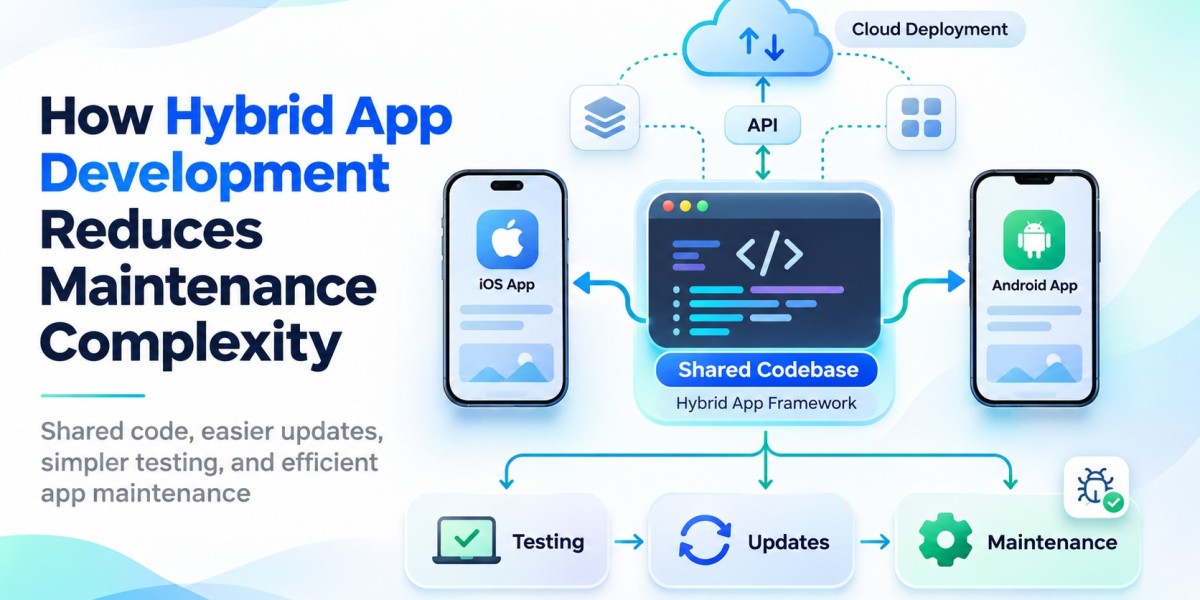
Hybrid app development offers an alternative by allowing businesses to share much of the application code across platforms. Instead of maintaining two largely independent applications, development teams can manage common functionality through a shared codebase.
However, lower maintenance complexity doesn't mean eliminating platform-specific work. The benefits depend on application architecture, technology selection, and how efficiently developers manage shared components.
Why Mobile App Maintenance Becomes Complicated
Mobile applications continuously evolve after deployment.
Businesses introduce new features, address customer feedback, update integrations, and respond to security vulnerabilities. Developers must also ensure that applications remain compatible with new Android and iOS versions.
With separate native applications, these changes may involve different programming languages, frameworks, and development environments.
For example, updating the payment workflow in an Android application doesn't automatically update the equivalent iOS implementation.
Both versions may require separate development, testing, and deployment activities.
This creates several challenges:
Duplicate development work for common features
Inconsistent functionality between platforms
Additional testing and quality assurance requirements
Different release schedules
Higher coordination requirements across development teams
As the number of features increases, maintaining consistent behavior across platforms becomes more demanding.
How a Shared Codebase Simplifies Application Updates
One of the main advantages of hybrid app development is the ability to reuse application code.
In traditional hybrid applications, technologies such as HTML, CSS, and JavaScript are commonly used to create interfaces that run inside a native application container.
Frameworks such as Ionic and Capacitor help developers build and deploy web-based applications while accessing supported native device capabilities.
Related cross-platform technologies, including Flutter and React Native, also support shared application logic, although they use different rendering and architectural approaches.
The maintenance benefit is similar: developers can implement many changes once instead of rebuilding the same functionality independently for Android and iOS.
Consider a retail application that needs an updated loyalty rewards interface.
With a well-structured shared codebase, developers can modify common interface components and business logic centrally. The changes can then be tested and released across supported platforms.
This reduces duplicated effort and makes feature consistency easier to manage.
However, device-specific functionality and operating system requirements may still require separate adjustments.
1. Reducing Duplicate Bug Fixes
Bug fixing is a continuous part of mobile application maintenance.
Errors can occur in authentication, form validation, data synchronization, navigation, and API communication.
When Android and iOS applications use independent implementations, the same logical defect may need to be investigated and corrected separately.
A shared codebase can reduce this repetition.
For example, suppose a booking application incorrectly calculates cancellation fees because of an error in its business logic.
If both platforms use the same implementation, developers may be able to correct the underlying logic once.
This can help prevent inconsistent behavior across devices.
However, platform-specific bugs still exist. Problems related to permissions, notifications, device hardware, and operating system behavior may require separate fixes.
The advantage is not that every bug disappears. It is that fewer shared functions need to be maintained independently.
2. Making Feature Updates Easier to Manage
Customers expect mobile applications to improve regularly.
Businesses may need to introduce new payment methods, update dashboards, add account management features, or improve navigation.
In applications developed separately for Android and iOS, feature delivery can become uneven.
One platform may receive an update earlier because its implementation is simpler or its development team has more capacity.
Hybrid development can reduce these differences by allowing common features to evolve together.
Shared UI components, validation rules, and API integrations help maintain consistency.
For example, a business introducing a new customer feedback form can reuse much of the same implementation across both platforms.
This reduces coordination overhead and makes synchronized releases easier.
A shared codebase doesn't guarantee identical experiences, but it can reduce the effort needed to maintain consistent functionality.
3. Simplifying Security Updates
Security maintenance is essential for applications that handle customer accounts, payments, or sensitive business information.
Developers must regularly address vulnerable dependencies, improve authentication flows, review data storage practices, and maintain secure API communication.
With a shared codebase, many security improvements can be implemented centrally.
For example, if an application uses shared authentication logic, developers can update its validation or session-handling behavior without maintaining two completely separate implementations.
Centralized dependency management can also reduce duplicated review work.
However, hybrid applications introduce their own security considerations.
WebView configurations, JavaScript dependencies, native plugins, secure storage, and communication between web and native components all require careful attention.
An experienced development team should evaluate these risks rather than assuming shared code automatically provides stronger security.
4. Reducing Testing and Quality Assurance Overhead
Testing is one of the most time-consuming parts of mobile application maintenance.
Every significant update may require developers to verify application functionality, usability, security, and compatibility.
Maintaining separate native applications often means supporting different test implementations for similar features.
Hybrid development creates opportunities to reuse automated tests for shared business logic and interface behavior.
For instance, tests covering registration validation, pricing calculations, or API error handling may be reusable across supported platforms.
Continuous integration pipelines can also automate common checks whenever developers update the code.
Still, cross-platform testing remains necessary.
Android and iOS can behave differently when handling notifications, file access, permissions, keyboards, and background processes.
Real-device testing is particularly important for applications that depend heavily on native functionality.
The objective is to eliminate unnecessary testing duplication, not to skip platform-specific quality checks.
5. Improving Long-Term Code Maintainability
As applications grow, maintaining clean and understandable code becomes increasingly important.
Poorly organized applications can become difficult to modify, regardless of the technology used.
A shared codebase gives development teams an opportunity to organize functionality into reusable components and modules.
For example, authentication, API communication, form handling, and common interface elements can be maintained through clearly defined application layers.
This structure makes it easier to identify which components require changes when business requirements evolve.
It can also simplify onboarding when new developers join the project.
Instead of learning two entirely separate application implementations, developers can focus on the shared architecture before working with platform-specific components.
Nevertheless, maintainability depends on code quality, documentation, testing practices, and architectural decisions.
A poorly structured hybrid application can be just as difficult to maintain as a poorly structured native application.
6. Managing Third-Party Integrations More Efficiently
Modern mobile applications rarely operate independently.
They often connect with payment gateways, CRM platforms, analytics services, authentication providers, and cloud-based APIs.
These integrations require ongoing maintenance.
External providers may update their APIs, change authentication requirements, or retire older endpoints.
With separate native implementations, developers may need to update integration logic on both platforms.
A shared application architecture can centralize much of this work.
For example, if a CRM provider changes an API response format, developers can update the common data-handling layer rather than rewriting the same logic twice.
However, integrations that depend on native software development kits may still require platform-specific development.
Before choosing a framework, businesses should verify whether essential third-party services have reliable integration support.
7. Simplifying Release Management
Managing mobile application releases involves more than writing code.
Development teams must coordinate testing, versioning, application store requirements, dependency updates, and production deployments.
When Android and iOS applications have independent codebases, coordinating releases can become challenging.
Hybrid development can simplify this process by allowing common changes to be managed through a unified development workflow.
Automated build pipelines can generate platform-specific application packages from the shared project.
This makes it easier to coordinate releases and track changes.
However, businesses must still meet Google Play and Apple App Store requirements independently.
Platform-specific signing, permissions, review processes, and operating system compatibility remain part of release management.
Shared development reduces some operational complexity, but it doesn't remove the need for separate platform validation.
Does Hybrid App Development Always Reduce Maintenance Costs?
Not necessarily.
Maintenance savings depend on how much functionality can be shared and how frequently developers need platform-specific changes.
For applications built around forms, dashboards, content, bookings, and API-driven workflows, hybrid development can reduce duplicated maintenance work.
Applications that rely heavily on advanced graphics, complex background processing, specialized hardware, or performance-sensitive native features may require more platform-specific engineering.
Businesses should also evaluate the long-term support and stability of the chosen framework.
A technology with limited plugin support or frequent breaking changes could increase maintenance effort.
Before selecting a hybrid app development company, businesses should ask how the proposed architecture will handle operating system updates, third-party dependencies, automated testing, and future application requirements.
The goal should be sustainable maintenance, not simply the lowest initial development quote.
Hybrid vs. Native App Maintenance: Key Differences
| Maintenance Factor | Hybrid App Development | Separate Native Applications |
|---|---|---|
| Code maintenance | Shared code for common functionality | Separate platform implementations |
| Bug fixes | Many common fixes can be reused | Similar fixes may require separate changes |
| Feature updates | Easier to coordinate shared features | More independent implementation work |
| Testing | Shared tests plus platform-specific checks | Separate platform testing workflows |
| Security updates | Common dependencies and logic can be updated centrally | Platform-specific code and dependencies require separate maintenance |
| Native integrations | May require plugins or native code | Direct access to platform-specific APIs |
| Release management | Shared development workflow with separate platform builds | Separate development and release workflows |
The actual maintenance advantage depends on application requirements and the amount of platform-specific functionality involved.
Read Also: Why Mobile Architecture Matters More Than Flutter vs React Native
How to Keep a Hybrid Application Maintainable as It Grows
Selecting hybrid development is only the first step. Businesses also need development practices that support long-term application quality.
A maintainable application should use modular architecture, reusable components, clear API contracts, and consistent coding standards.
Automated testing and continuous integration can help teams detect problems before deployment.
Developers should also review outdated dependencies, monitor application crashes, and test compatibility with major operating system releases.
Another important practice is limiting unnecessary customization.
If developers repeatedly introduce platform-specific workarounds for features that could use shared implementations, maintenance complexity may increase.
Regular technical reviews help teams identify these issues before they become expensive to resolve.
Final Thoughts
Hybrid app development can reduce mobile application maintenance complexity by consolidating common code, simplifying feature updates, and improving consistency between Android and iOS applications.
The benefits become especially valuable when businesses manage applications that require frequent changes, multiple integrations, and ongoing functionality improvements.
However, shared code alone doesn't guarantee lower maintenance costs. Architecture, testing, security, framework support, and developer experience remain critical.
For businesses planning a new mobile application or modernizing an existing product, Spaculus Software provides hybrid app development services focused on practical business requirements and cross-platform application delivery.
Ultimately, the right development approach should make an application easier to improve, secure, and maintain throughout its lifecycle, not just faster to launch.